|
A Not/Applicable & Heart Productions joint production
Shooting Clouds:
photo by Stage Photo . com
Written by Frank Bramwell Directed by Arnaud Mugglestone Union Theatre
A review by Alice MacKenzie for EXTRA! EXTRA!
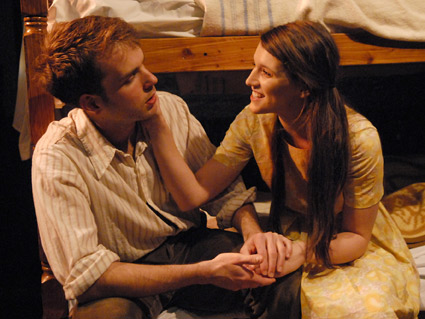
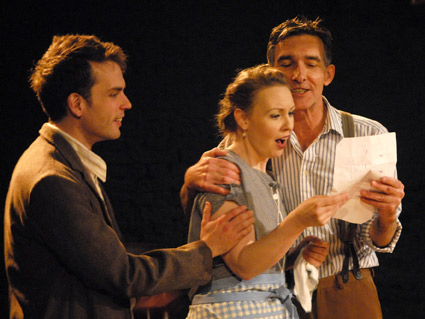
Set in the run up to the 1958 Recession, Shooting Clouds: Shattered Dreams/Wounded Pride narrows in on the lives and fortunes of one small-town Georgian family, the shop owning Pearsons. The 1958 Global Recession had an unusual effect on America: unemployment rose, but so did import prices, resulting in higher prices for most manufactured goods. So people stopped buying. The Pearson family encompasses a bank manager cum deeply conservative preacher, a shop owner with dreams of expansion and a left-wing writer. Through this family, writer Frank Bramwell transforms the global crisis of 1958 into a powerful story of bitter brotherly jealousy, familial duty, hope, disappointment and small town conservatism. The audience takes to their seats almost within the Pearson's family home, while Jennifer Belander's Mary, the smiling picture of a 1950's housewife, sits in her kitchen playing Patience. The card game runs right throughout the play, a methodical waiting game where the players shuffle and reshuffle until the right card emerges at the right time. Will, played by Damian Sommerland, the radically left-wing eldest son of John and Mary, takes from his family business to leave an anonymous donation on the grave of a struggling widow, and in this act of humanitarian intervention shapes the fortunes of both his family and the town and sets in motion a debate on charity, dignity and aid. Will interrupts his girlfriend Ann's (a sparkling Mariam Bell) game of Patience to point out a card to carry over, "I know! I was saving it..." she replies angrily, highlighting their differing approaches to life. Bramwells' script is laced with subtle echoes that link the actions and conversations of the Pearson family both to the wider context of 1950's America with its economic boom and bust, and the ideological battle against communism, and also perhaps to our own economic crisis, half a century later. For in Will's actions the town sees a 'miracle', and from that belief and hope a small economic miracle grips the town as people come from far and wide and the townspeople believe themselves blessed. Perhaps at the moment we too are being reminded that belief, confidence and rumour can have a very material effect. Or perhaps Patience is just a concentrated way for the actors to pass the time as they wait for the spotlight to return to them? Edward Lidster's lovely set pulls away the walls of the Pearson family home, allowing us to peer into the kitchen, dining room and the two adult sons’ bunk-bedded bedroom all at once. Adi Shimrony's lighting guides us smoothly in and out of each room giving the play a cinematic quality. The scenes move easily between rooms and conversations, revealing furtive glances and private moments that are hidden to the characters waiting in the next room. Likewise, the passing of time is dealt with in a subtle yet geekily pleasing way. The attention shifts to the sudden intrusion of the family radio as it skips between channels playing Johnny Cash songs and news bulletins about Korea, or later on in the play announcing the death of Pope Pius XII (1958, I looked it up...). And behind all of this, the frequent and soft rumble of the trains heading to Waterloo Station as they passed above the Union Theatre, nestled under the railway arches. This grumble was strangely comforting at some points, at others added to the tension and sense of impending doom. The trains, although not written into the play, seemed to signal the come and go of people through this small town, and a link to the outside world. You can tell it’s a good play when you want to stand up in the middle of a scene and demand that the characters take back their decisions, or persuade them to see things from the privileged view of the audience. This was a play firmly set in a time and place where the head of the household was the man, the women drank lemonade while the men drank bourbon, family duty was upper-most and the older son automatically inherited the world. I was so involved in the manipulative jealousy of the disappointed younger son Gilbert, played all too convincingly by Thomas Coombes, that my annoyance and sense of powerlessness mounted while the rest of the characters seemed oblivious to his hand in events. The script for Shooting Clouds is strong enough to draw the audience into the Pearson’s world, and the performances of the cast good enough to persuade you to believe in them and their relationships as they each try to find their way. It became clear that this tale of brotherly jealousy and pride was a repeat of the relationship between the father, John, the charismatic Francis Kennedy, and his own younger brother Donald (Bret Jones). This sense of history repeating itself was reflected in the references to the Great Depression of 1929, and in the suggestion for us to compare the events of the play to our own time. Setting the play in the seeming distance of 1950's small town America allows this engaging, funny and frustrating play to ask questions of the audience about our own economic crisis. Perhaps more challengingly, it also raises a discussion about our relationship to aid, charity and personal ambition. My only piece of advice to future audience members is to wrap up warm! On the night I went to see Shooting Clouds the weather had just changed and most of the audience sat in their coats. But don't let this put you off. Just wear a warm jumper and enjoy being invited into this family living room.
photo by Stage Photo . com
Box Office: 0207 261 9876 Tickets: £12, £10 concessions. Performances run Tuesday to Saturday at 7.30 pm Union Theatre
|
 ary Couzens